Style Lens
A smarter fitting room for more confident choices.
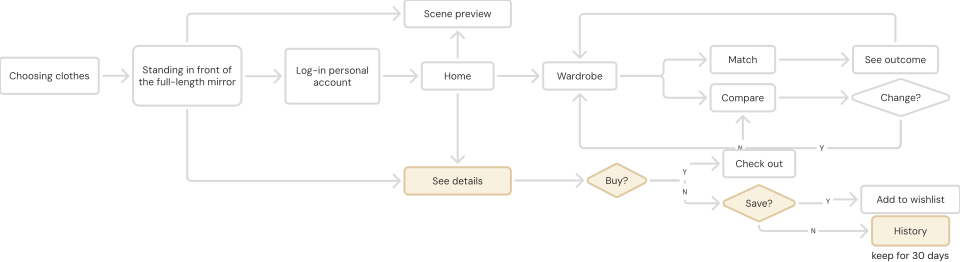
StyleLens reimagines the fitting-room mirror as a decision-support interface. It brings product information, real-world context, a digital wardrobe, and comparison into one experience.
- ROLE
- UI / UX design
- TYPE
- Individual Project
- YEAR
- 2025
01 / THE PROBLEM
Too much choice. Too little clarity.
Background
Analysis for competitive products
- Z-Generation Preference: Gen Z is evenly split (50/50) between online and offline shopping, with 97% of these digital natives still frequenting physical malls.
- Generational Shift: While consumers aged 30+ in China prefer the tactile experience of physical stores, younger shoppers typically conduct extensive online research before visiting a store.
The Demand for Experiential Retail
- Shopping for Fun: 31% of consumers visit brick-and-mortar stores primarily for entertainment and "the joy of discovery."
- AI Readiness: There is a high appetite for innovation, as 71% of Gen Z consumers express a strong willingness to use AI-assisted fitting and styling tools (Deloitte, 2024).
Market Growth & Scalability
- Market Value: The global virtual fitting room market is projected to reach $13.4 billion by 2025.
- Rapid Expansion: The industry is experiencing an annual growth rate (CAGR) of over 20%, highlighting a significant opportunity for smart retail solutions (MarketsandMarkets, 2023).
Problem Features

- Tactile Focus
- Immediate Ownership
- Physical Exploration
- High Friction
- Opaque Data

- Efficiency First
- Infinite Inventory
- Tactile Deficit
- Sizing Uncertainty
- High Return Rates

- Contextual Gap
- Decision Paralysis

- Persistent Mobile Reliance
- Data Scarcity
Persona & User Journey Map

Emma, 28
Project Manager, highly tech-savvy
Core Pain Points
- Low Fitting Efficiency: She finds the repetitive process of dressing and undressing in fitting rooms tedious and a significant waste of time.
- Decision Fatigue: Faced with overwhelming choices, she feels paralyzed and struggles to quickly identify which item best suits her.
- Lack of Information Transparency: She dislikes manually searching for sizes or asking staff for prices, preferring the convenience of online research.

POG
How might we help users reduce their waiting time in queues?
How might we help users better locate the products they need?
How might we ensure that the items users need are in stock, or fulfill their needs immediately when an item is out of stock?

How might we provide consumers with personalized services, such as recommendations or mix-and-match suggestions that align with their individual style?
How might we increase the sense of immediate gratification for consumers in physical stores?
How might we improve customers' product knowledge during physical shopping?
How might we ensure a smooth shopping experience by preventing issues caused by insufficient staff training?
How might we help consumers avoid staff members with poor attitudes?
How might we provide personalized services, such as recommendations or mix-and-match suggestions that align with an individual's style?
How might we reduce the sense of loneliness experienced by customers while trying on clothes?

How might we reduce the frequency and time required for consumers to change clothes when making a purchase decision?
How might we enrich the amount of information available during in-store shopping?
How might we synchronize prices across different platforms?

How might we help shoppers filter through overloaded information?
How might we solve the issues of insufficient fabric precision and low fidelity in AR fitting?
How might we reduce the frequency and time consumers spend changing clothes when making a purchase decision?
How might we reduce the difficulty and time for users to find the right size?

How might we help consumers decide which clothes are right for them?
Identify POG with highest priority
HMW:provide customers in physical clothing stores with a more supportive and informative try-on experience, helping them make confident decisions without feeling overwhelmed?
Ideation
Digital Wardrobe Integration
A categorized digital interface that allows users to upload their personal wardrobe and virtually "mix and match" their existing pieces with in-store new arrivals.
Immersive Scene Simulation
An AR-powered mirror feature that allows users to virtually switch between different backgrounds and lighting settings (e.g., "Street," "Office," ) to test outfit suitability.
AI Styling Assistant
An AI-driven companion that provides empathetic styling suggestions, real-time mix-and-match advice, and feedback based on the user's selected items.
Side-by-Side Smart Comparison
A dual-mirror display that provides side-by-side real-time comparisons of different outfits, integrated with an AI scoring system for style and fit.
Social Collaboration & Remote Feedback
An AR-enhanced remote sharing feature that syncs the mirror view with a friend’s device, allowing for real-time remote consultations and feedback.
Automated Garment Retrieval System
An integrated request system within the mirror interface that allows users to summon new sizes or colors to be delivered directly to the fitting room.
02 / EXPERIENCE
Make it clear
01 Information Aligned
81% of consumers conduct online research before making a purchase, primarily because physical stores often lack comprehensive product details, cross-platform price comparisons, and user reviews.

The smart mirror acts as an "in-store search engine," allowing customers to sync real-time platform pricing and product specifications directly within the fitting room. This delivers the "AR-driven product confidence" sought by 56% of consumers.


02 Scene Preview
Customers struggle to visualize how a garment performs in different real-world contexts, leading to decision fatigue for 68% of shoppers when comparing multiple outfits.
The Smart Mirror provides Environment Simulation, allowing users to virtually switch backgrounds and lighting to validate the outfit's suitability for specific scenarios (e.g., office vs. gala).


03 Home & Main Interaction
Shoppers often suffer from "Wardrobe Amnesia" while in fitting rooms, struggling to recall their existing clothes to match new items. This information gap leads to decision fatigue and inefficient shopping sessions.
The home screen digitizes personal assets through a categorized swiping interface. It streamlines the pre-selection process, allowing users to mentally "assemble" outfits in seconds, transforming physical fitting into a high-speed visual filter.


04 Your Styling Assistant
While trying on multiple outfits, shoppers often struggle to recall the exact look and feel of each combination, leading to "memory decay" during the final decision-making process. They lack a tool to capture and preserve the fleeting aesthetic inspiration found in front of the mirror.
Outfit Snapshots allow users to save complete looks as digital assets, building a personal database for more confident decision-making.


05 Smart Compare
Shoppers often struggle to distinguish subtle differences between two favorite items due to "memory decay" and aesthetic fatigue, leading to high drop-off rates at the final decision stage.
The Dual-Mirroring feature enables real-time visual comparison, while the AI Scoring System (Fit, Style, Scenario, Trend) provides data-driven insights to help users make a definitive and confident choice.


03 / EXPERIENCE
Enjoy your brand-new fitting room!
01 Information Aligned


04 / Reflection
Design for a clearer decision.
StyleLens is a concept exploration. Its next step is to test whether the experience lowers comparison effort and improves confidence during try-on.